Automated Outbound Growth Machine · Lesson 1 · Video
What It Takes & Timelines
Lesson resources
Action items
0 / 1 done▸ Show transcript▾ Transcript
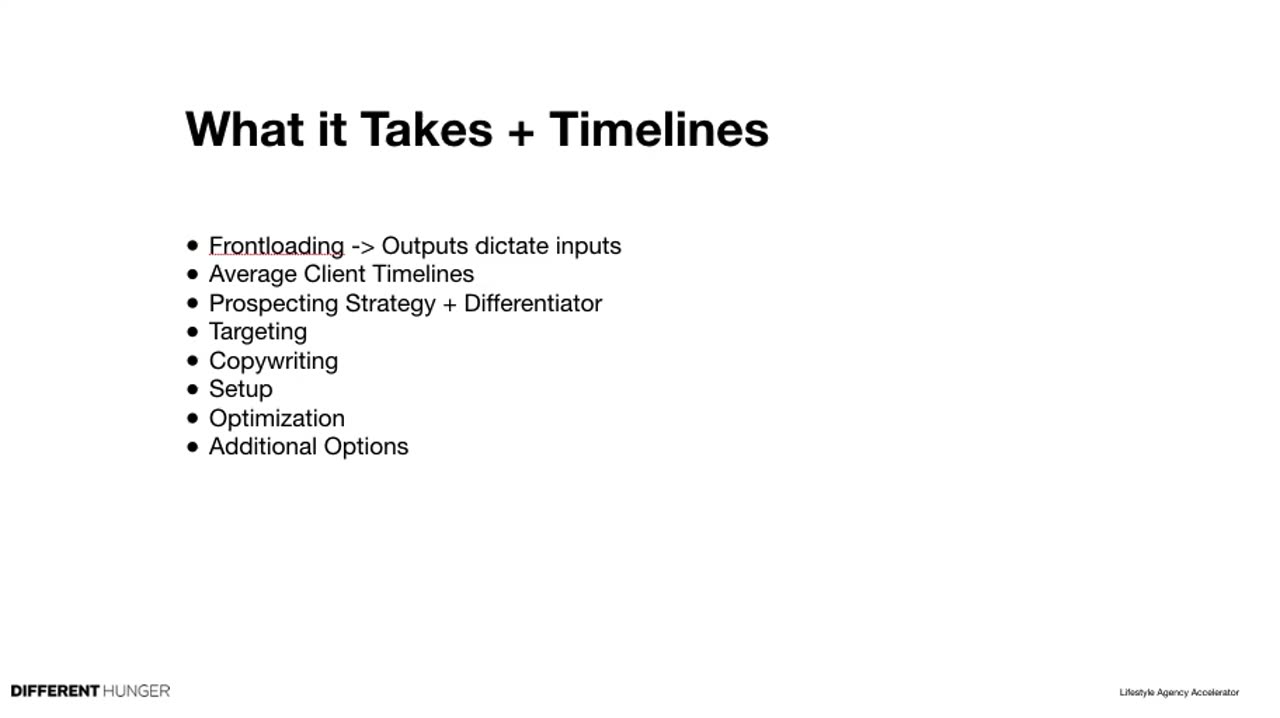
Hey guys, it's Barbara Palinde here and today we're going to go over, you know, what it really takes to, you know, jumpstart your journey to start getting those two to five clients a month and what the timeline is going to be. And so before I begin, I want to go over a couple different things. One is we're going to do a lot of work up front and
that's because the more work you do up front, the easier it'll be to cruise later and you can, you know, start setting up your team, et cetera, et cetera. And your outputs will really dictate your input. So the bigger your goals, the more work you're going to have to do up front. But you're going to have a better system as you go. So just keep that in
mind. The bigger your goals, the more work you'll do, but, you know, it's worth it, so it's cool. So we used to run this program, what I'm about to show you for clients as a service. And so I'm going to show you exactly how long you used to take for us to run it for our clients. So that way you have good expectations of what's going to
take for you. People have done a lot of faster. I just want to make sure you have some sort of benchmark. Next is we're going to go over your prospecting strategy and your differentiator. Then we're going to go through some targeting, how to do some copywriting, how to set the entire thing up, how to optimize and when to optimize, and then some additional options that you can
go through. So first of all, you know, it's going to take about 30 days of strategy and set up to go through this type of thing. And the first week is kind of you're getting on board with it to it, doing the prospecting strategy, identifying exactly where you're going to go after next week or so. You're going to go out just targeting, really honing exactly who you
can go after, not just who you should go after. The biggest bottleneck in most how about campaigns is actually the prospecting. So you learning what the target is really important here. Then before we tease over, we want you to go through copywriting and we'll give you some scripts for that. We'll want you to edit them a little bit for your prospecting markets, but that should take about
a week. And then in weeks two to four, we want you to do some test outreach to try out some messages, see what responses look like, and then finish setting everything up and launch it. And then every 30 days, as you can tell over here, we want you to go in and review all the things that you have, prospecting, targeting, the copywriting, and the average will be
outgoing. Sorry. All right, so we're going to do a couple of things here. We're going to start off some market research and guys, you have to do this kind of stuff. I know you've probably already done it. I know you've probably said this really well, but if you don't answer these questions now, it's not going to inform your strategy very well. So go ahead and walk through
every single one of these. And you'll see this document attached, and let's see if I can make sure it fits in this window. Here we go. And this is our market research document. It's a couple of questions that you're going to go through. I prefer you answer them as thoroughly as possible. It's not necessary. You can probably do this in a couple sentences each. So you're by
our persona. If you don't have this, go fill out the entire customer avatar worksheet so you know exactly what your persona is. Identify your top two case studies and list accomplishes with them. If you don't have case studies, it's okay. You can still get a lot of sales without them. I've got companies without any case studies, but it is better if you do have them. List your
top two content marketing pieces. It's okay if you don't have any, but your top three competitors down. Go through a swan analysis, and I'm going to remind you the more you do right now, the less you're going to have to do it later. So go through all this. What are your strengths in the market? You know, what can you do better than most people? What are you
really good as a company? What are your weaknesses in the market? Like what's going to stop you from being really successful? What are your opportunities? What are the glaring problems that people have that you can kind of jump on? And then what are the threats to your business in the market? And you cannot write. We have no threats. You have threats, everybody has threats. All right. What
is your value proposition? Put it in the following format. I help blank, do blank by blank. This is insanely important. When you get this statement right, people will beg to work with you. So really, really put your brain into this and use as little jargon as possible to simple this statement better. All right. So now write your ideal customer persona in three sentences and then identify which
industry to target, what company size you work with, and then what are the job titles, the key decision makers you talk to. And again, all of this will go into targeting later on, so fill this all out. All right. Once you're done with that, we're going to be copying your own section. And so your V1 messaging script, we're going to pull it up. And both of these
are attached below. And we have attached a lot of templates. So there's a couple of different places you're going to be posting these things. There's groups that you don't really know. I think about, and you're going to go to the post, group post in there. Whenever someone asks you when you do, we're going to have a little fill in the blank kind of script here. So just
fill that out. Whenever you get a new friend request, you can respond with this. Whenever someone's not ready for a call, yeah, you can respond with this. When someone, you know, so you want to be asking people all the time, what are you working on this month? It's innocuous. It shows that you care about what they're doing and you should care about what they're doing, because that's
how you're going to find the problems that you're going to solve for them. And then you respond with this. When someone asks you what you do, go into this offer and fill in the blanks. And so when someone requests a call, I don't like the booking link. This is better for when, you know, you're further along, but for now we put this in here in case you
have the jitters, I guess I want to call it. And then if someone doesn't want to have a call with you, just, you know, have a nice casual thanks so much. If someone asks for how the call works, you know, this is an explanation of how to do it. And then here is an invisible pitch, quote unquote, a way to sell your product without selling it off
to feedback instead. Cool. So go ahead, fill those out guys. It'll really, really help. And we'll keep going. And I believe it's module six. We keep updating this. It might be different. But we're going to go into the channel profile optimization. Optimize your profile. LinkedIn, and optimize your Facebook. Facebook. How to optimize your profile for email, and how to optimize your website. And that module I believe
is called branding for growth. Cool. So yeah, guys, go ahead, fill those things out. It'll help you immensely once you do have messages coming in. All right. So make sure your payment portal is set up. Make sure you're able to take payments at this point. Make sure you have your case studies. Even if you don't have personal case studies, you can go out and find examples of
people using, you know, doing something similar. That works really well. If you have a proposal system, go ahead and set that up. I don't recommend proposals. It puts the power in the client's hands, but we can get into that later. If you have recurring payments, make sure that's all set up. And then go set up your LinkedIn, go set up your Facebook, and that'll really, really happen.
Okay. Once a month, you're going to optimize these things. You're going to tweak prospecting, targeting, and copywriting for the first two weeks of the campaign in the month, one, week, two. You're going to have to hit right in the message to get some responses, but once you hit that responses, kind of run, then start optimizing once a month, you should be tracking the following things. If you're
doing outbound email, which we don't teach in this course, but, you know, if you guys ask, we can show you how to set it up. You want to look at your leads, your close rate, and your objections. And for LinkedIn, you want to look at the reply percentage and leads. And the same thing with Facebook, reply percentage, the number of leads you can lead, so it would
be the actual calls that you have. All right. Additional optimizations that we like, A-B testing, super important. Facebook retargeting, perfect audience retargeting, ad role retargeting is phenomenal at boosting what you're doing. People see you everywhere. I definitely recommend these things, but if you are, you know, making sure you get up and running really quickly, go ahead and skip them and you can come back to them later.
And guys, lastly, just get to work, go through the strategy. Make sure you fill out the entire document so you know exactly if you're targeting, why you're targeting, how you're targeting. Go through the setup process, it's going to come in a module or two after this. And go through your copywriting, make sure you fill out those templates so you're ready to respond to people when it's time.
And you'll be launching your campaign after. Good luck, guys. Get to work.